
How Athens Busted Mugshots Begin
Athens anchors the unified Athens-Clarke County government and serves as the county seat. The 2020 Census put 128,671 people inside the consolidated government. Strip out the separately incorporated places. The balance figure drops to 127,315. That number best describes Athens itself. One county, several badges. That is why a single Athens arrest search can touch multiple agencies without ever leaving the same system.
Division of labor matters here. ACCPD handles general city-county policing. UGA Police work campus matters. The Clarke County Sheriff's Office runs the jail, serves warrants, and guards the courts. State and federal officers can also book people into the local facility. Once someone is booked, the jail's custody systems are the main public path to the record. No separate Athens mugshot blotter exists.
Where Athens Busted Mugshots Get Published
Each official channel answers a different question. The current prisoner table gives a delayed custody snapshot. The seven-day recap works as an event record and can keep a released booking visible briefly. ACCPD and UGA Police publish incident information, not a full photo roster. Need a booking sheet or intake photograph? A focused records request is the official fallback.
| Channel | Photo or record | Status and Athens use |
|---|---|---|
| CCSO current prisoner list and its live table | Text table; no photo column | Official current-custody view after a 24-hour delay. It refreshes every 15 minutes and displays the first charge only. |
| CCSO seven-day arrests and the booking recap | Text booking and release rows; no photo feed | Official event view after the same delay. It remains available up to seven days after arrest and includes releases. |
| ACCPD incident tools | Incident details, not a booking photo | Official Athens-Clarke source. The Community Crime Map reports incident type, block-level location, and date/time, not who was booked. |
| UGA Police daily log | Photo-free incident or report summary | Official campus source. It is not a jail roster, booking feed, or proof of a court result. |
| Police/Corrections Open Records Center | Requested report, booking sheet, or photo when held and releasable | Official request route. Ask ACCPD for its incident report and CCSO for the jail booking record or intake image. |
| Local news: OnlineAthens, Classic City News, WGAU, Red & Black, Flagpole, and WUGA | Story photos vary | Secondary and selective. Coverage can be stale, episodic, or limited to notable events, so confirm custody and disposition with official sources. |
| Georgia Gazette Clarke County | Unofficial booking-style coverage may include images | Third-party county archive. It is a discovery lead only and does not control current custody or the final court result. |
Expect text, not pictures. Neither county view works as a gallery. Even when a linked detail view shows a face, that proves nothing about what CCSO created or can release, and a blank field proves nothing either. The record custodian decides what gets released, what gets redacted, and how any withholding gets explained.
Busted in Athens: Locate the Booking
Precision beats volume in an Athens lookup. Start with custody. Move to the correct agency record. Then carry the case identifier into court follow-through. For the wider picture, the Clarke County booking hub pulls together the countywide roster and feed details. It also explains the shared jail systems behind every Athens search.
- For a person who may still be held, open the CCSO current prisoner list and use the browser's find function on the rendered table. Allow for the 24-hour publication delay, and read the first-charge-only heading before interpreting a row.
- For a booking or release within the prior week, use the seven-day recap. Search the surname, then compare the MID and booking time across repeated rows. Multiple rows can be multiple charges from one booking, not multiple arrests.
- Read the ARRESTING AGENCY field. ACCPD, UGAPD, CCSO, Winterville Police, or another agency points to the office that may hold the incident report. The field identifies the source of the booking, not guilt.
- Use the ACCPD Community Crime Map for incident type, block-level location, and date or time when the event was handled by city-county police. Do not treat the map as a booking or photo feed.
- Use the UGA Police daily log for a campus incident summary. If a UGA event led to a jail booking, the CCSO recap is the custody source and UGAPD should appear as the arresting agency when populated.
- Request the specific report, booking sheet, or intake photograph from the correct custodian when the online tables do not answer the question. If the person was sentenced into state custody, use the Georgia Department of Corrections offender search guidance and its official search form, which are not a recent Clarke County arrest feed.
Timing quirks trip people up. The current list can still show a person in custody long after the original booking date. Someone released may drop off that list after an operational update yet linger in the seven-day recap. A name missing on day one does not mean release. And a Georgia Department of Corrections result never replaces the local booking record.
ACCPD Records for Athens Arrests
Two different records live behind one arrest. The police event and its report belong to ACCPD. The booking sheet and intake photograph belong to the jail, so those questions go to CCSO. Route requests through the Police/Corrections Open Records Center. For ACCPD records questions, call 762-400-7370. A report documents the event and the agency's response, nothing more.
Athens-Clarke County Police Department
Administration and East Precinct
3035 Lexington Road
Athens, GA 30605
Main: 706-613-3330
Non-emergency: 706-613-3345
Records questions: 762-400-7370
Use the Police/Corrections Open Records Center route for the request.
CCSO Sheriff Open Records
Shannon Brown
Open Records delivery: 325 East Washington Street, Room 100
CCSO main office: 325 East Washington Street, Suite 125
Athens, GA 30601
Open Records: 762-400-8013
Main office: 706-613-3250
Jail: 706-613-3270
Keep the request narrow. A clear, specific ask helps the custodian find the record and ties the question to one booking rather than a whole collection of images.
- Name the record type: ACCPD incident or arrest report, CCSO booking sheet, or CCSO booking or intake photograph.
- Provide the subject's full name and, if known, date of birth, approximate arrest or booking date, MID, police case number, or warrant number.
- Ask CCSO for the booking sheet and the booking or intake photograph associated with that booking. Ask ACCPD separately for the police report when the agencies are not the same custodian.
- Use the written response to track any estimated cost, redaction, or statutory reason for withholding. Georgia's public-record response framework generally calls for a response within three business days when records are available, but that is not a promise that every record will be produced in three days.
- Review the returned record for the difference between booked charge text and court disposition. If access is limited, retain the explanation and use the appropriate court or clerk path for the final case result.
Fees track the work involved: search, retrieval, review, and redaction. The first 15 minutes of qualifying labor cost nothing. Paper copies run up to $0.25 per page. Electronic delivery gets offered when practicable. The sheriff's published fee page sets no flat booking-photo charge, so its other service fees should never be relabeled as photo fees.
Athens Booking Agencies Meet One Jail
The agency mix defines the Athens lookup problem. ACCPD makes general city-county arrests. UGAPD handles campus matters. CCSO acts in its own role. State or federal officers book locally. There is no complete ACCPD daily arrest log or mugshot blotter, and none of these agencies publish a shared Athens arrest feed. CCSO centralizes the jail custody record, which makes the arresting-agency field the bridge between the first report and the booking entry.
The ACCPD map and the CCSO jail report answer different questions. Use each for its own job. The map shows where an incident was reported, down to block level, and when it was logged. The jail report shows who was booked, which agency made the arrest, the charge rows entered at intake, release information, and the court jurisdiction. A map pin cannot imply a booking. A jail row cannot supply the map's incident location.
For the department's role and records route, the official ACCPD landing page is the source. Its link goes straight to the originating office. The agency context can always be checked there.
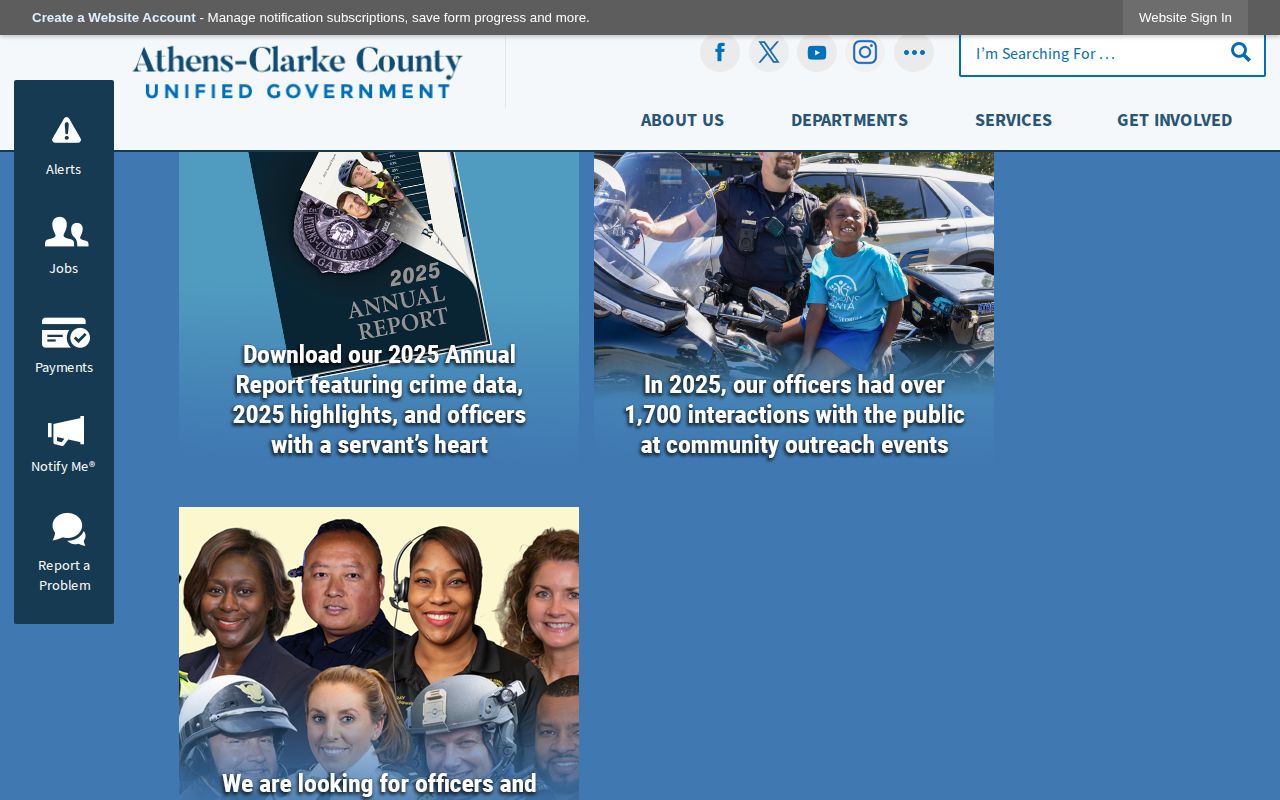
The police side and the custody side of an Athens arrest live in different places. An ACCPD account can tell you who made the arrest and why. That still leaves a question open. Who is actually held? For that, the CCSO current list and seven-day booking recap are the tools that answer it.
UGA Logs and Athens Busted Bookings
UGA Police handles campus matters. Its daily log offers an incident summary with no photos attached. It gives useful context around a campus event. Still, it is not a jail roster. It is not a booking-photo feed either.
A campus arrest can end in detention at Clarke County Jail. When that happens, check the CCSO seven-day recap after its publication delay. Look at the ARRESTING AGENCY field for UGAPD. The campus log and the jail row may describe two stages of one event, so match names, dates, and the agency with care before treating them as the same case.
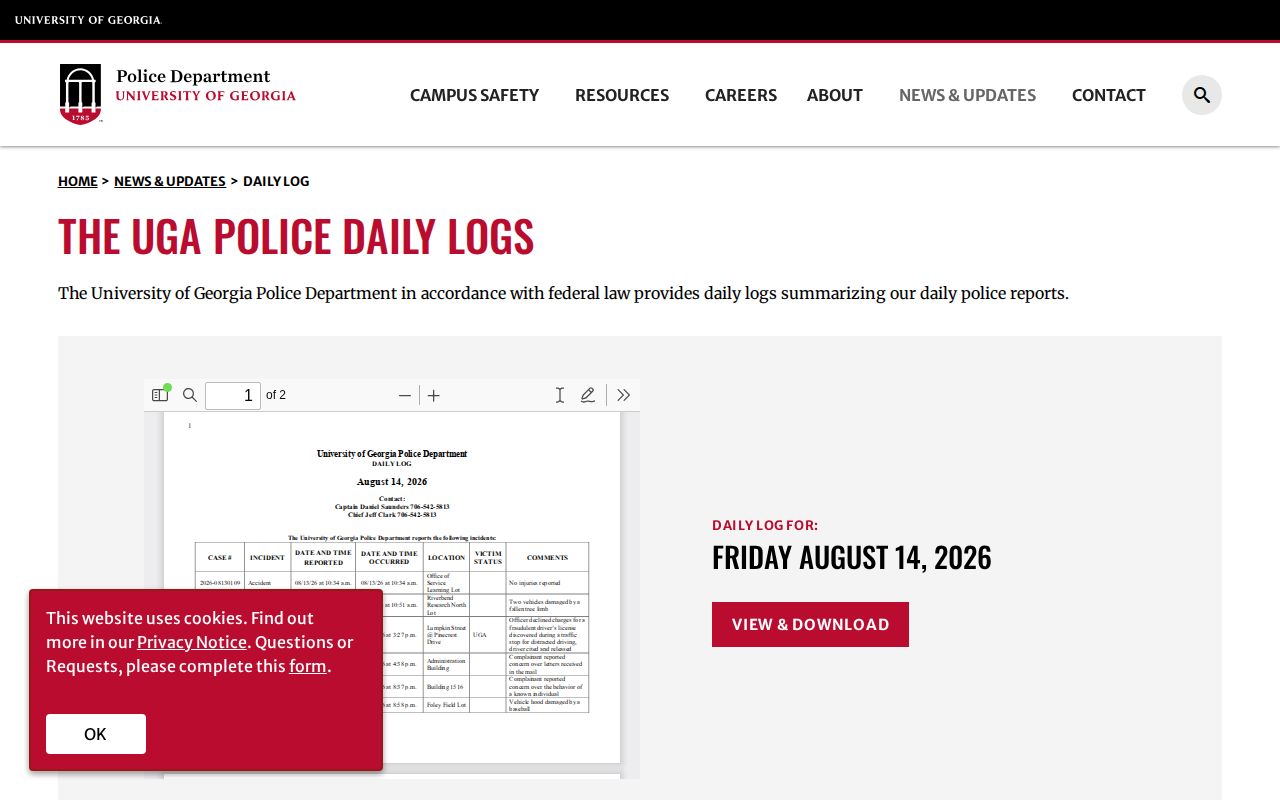
The daily log has real value: it preserves the campus agency's own account of the report stream. Still, read it alongside the county booking record and later court paperwork whenever a charge comes up in conversation.
Why Athens Busted Mugshots Can Wait
Patience is part of the process in Clarke County. The current prisoner list and the seven-day arrest recap both carry a stated 24-hour delay, and after that the reports refresh every 15 minutes. So there is no same-day feed. Someone booked in Athens this morning may be absent from both official web views until the next publication window, even while still sitting in the jail.
The two views also behave differently over time. The current list keeps a person visible while that person is recorded as held. The seven-day view tracks bookings for up to a week after arrest and shows release time, so it can list someone no longer on the current roster. Navigation labels sometimes use shorter wording, but the stated operating window is seven days.
One more wrinkle deserves attention. The current table shows only the first charge. The recap can list separate rows for separate charges under a single MID and booking time. So a repeated name line in Athens may simply be one booking with several charge entries. Bond amounts, release notes, and charges can all shift later. Treat the table as a snapshot from intake.
Georgia Law and Athens Busted Photos
Georgia law restricts how arresting agencies publish booking photographs. O.C.G.A. section 35-1-19 explains why Clarke County's official pages are text tables instead of a photo gallery. The statute does not make every booking image confidential. Nor does it promise that a requested photograph exists or will be handed over. The right move is a focused request to CCSO with the booking identifiers and any statement the custodian requires.
When a record ages out of the public web window, it has not been destroyed. Georgia's local public-safety retention schedule keeps jail booking records and their associated data for ten years after release. Incarceration lists have a shorter minimum period. The schedule does not separately guarantee ten years for each booking photograph, so ask CCSO which record series governs the image.
Sealed, restricted, juvenile, and otherwise protected records may not surface in public tools at all. No booking-photo gallery is hosted here. No third-party image should ever stand in for the originating record.
After an Athens Booking
The jail recap includes a court jurisdiction and case-number field. That pairing points toward the next official record. Athens-Clarke Magistrate Court runs first appearances and bond proceedings daily. Weekdays bring these hearings to the courthouse. Weekends and holidays move them to the jail. A first appearance deals with early process and release questions.
Downstream, the case may land in Superior Court for felonies, State Court for misdemeanors, or Municipal Court for ordinances and qualifying misdemeanor or traffic matters. Take the jurisdiction and case number from the jail row. Confirm the person's identity, then read the docket or final order. Arraignment is when the accused is formally called to plead. Disposition is the court's final outcome, such as dismissal, plea, or another resolution.
Magistrate Court information offers an official starting point for routing a case. If a person later enters a state sentence, the GDC offender search becomes the relevant custody channel. GDC photos appear only when available. GDC itself is not a recent Athens booking roster.
Athens Crime Coverage
Nobody in Athens publishes a full booking log. You have to piece it together. OnlineAthens Crime comes closest to daily coverage, tracking ACCPD, the Clarke County Sheriff's Office, UGA Police, the GBI, and the courts. Classic City News keeps a dedicated ACCPD category and covers public-safety events across metro Athens. WGAU adds radio reports, and The Red & Black follows campus arrests, city government, and court news from a student angle.
Flagpole goes weekly and deeper. Its pages cover policing, the jail, courts, and local politics, though access and publishing schedules shift. WUGA's Athens News Matters is a public-radio program that sometimes takes up court or public-safety policy, but it rarely functions as a booking-photo source. For the wider media trail, the Crime News page maps the county's outlets. CCSO and the courts stay the final word on custody.
One more lead deserves care. The Georgia Gazette runs a Clarke County section, an unofficial archive that may show booking-style images and leave them up after a release, dismissal, or correction. Treat it as a tip, not a record. News photos and headlines work the same way: they capture an agency statement at one moment. Verify the booking with CCSO and the outcome with the court handling the case.